Please Choose Your Language
Views: 0 Author: Site Editor Publish Time: 2026-07-12 Origin: Site
Retailers and brands constantly face a challenging merchandising gap on the store floor. You often have to choose between fragile, short-lived temporary corrugated units and capital-intensive permanent store fixtures. Temporary units break down quickly in high-traffic aisles, leaving your products scattered or damaged. Permanent fixtures demand massive upfront investment and lack the seasonal flexibility required for dynamic retail environments. Brands executing medium-term campaigns lasting three to twelve months frequently overspend on permanent fixtures. Alternatively, they suffer severe brand degradation when temporary displays fail mid-campaign. You need a reliable middle ground that holds up to daily abuse without locking you into a multi-year footprint.
Establishing a solid framework to evaluate semi-permanent displays offers a strategic solution for your merchandising strategy. This approach provides sustained retail visibility while balancing durability with logistical agility. You can secure prime floor space, withstand daily shopper interaction, and adapt to changing seasonal graphics seamlessly.
Optimal Lifespan: Semi-permanent displays are engineered for 3 to 12 months of active retail use, bridging the gap between temporary (1-3 months) and permanent (1-5 years) fixtures.
Material Versatility: Utilizing hybrid materials like reinforced corrugated board, plastics, and lightweight metals provides structural integrity without the shipping costs of heavy wood or steel.
Retailer Compliance: Successful deployment requires strict adherence to specific retailer footprint, height, and weight-bearing guidelines (e.g., club stores vs. grocery).
Understanding the operational window dictates your entire campaign planning process. We define the semi-permanent lifecycle strictly within the three-to-twelve-month range. This duration aligns perfectly with multi-season transitions, extended product launches, and sustained secondary placements. You avoid the rapid deterioration of standard cardboard while sidestepping the rigid permanence of welded steel. When you plan a rollout for a new beverage line or a seasonal cosmetic collection, the fixture must survive constant restocking. Store associates are rough on displays. Pallet jacks bump into them. Shoppers lean on them. A standard temporary unit will crush under this pressure within weeks.
To grasp the value, we must compare the full merchandising spectrum directly on the retail floor. Temporary displays focus on low cost and high volume. They typically last one to three months. High-traffic wear quickly destroys them, especially in grocery environments where floor scrubbers introduce moisture to the base. Permanent displays require high capital expenditure. They last one to five years using rigid wood or metal construction. Updating them for seasonal shifts proves incredibly difficult and requires specialized labor. The hybrid approach prioritizes modularity. It delivers moderate durability and cost-efficiency. You can easily swap graphic elements as campaigns evolve without replacing the core load-bearing structure.
Display Type | Typical Lifespan | Primary Materials | Best Use Case | Vulnerability |
|---|---|---|---|---|
Temporary | 1 - 3 Months | Standard Corrugated | Flash sales, short promotions | Moisture, cart impacts, heavy loads |
Semi-Permanent | 3 - 12 Months | Reinforced Corrugated, Plastics, Wood Accents | Seasonal transitions, product launches | Complex assembly if poorly engineered |
Permanent | 1 - 5 Years | Steel, Solid Wood, Acrylic | Flagship brand installations, category anchors | Inflexible footprint, high freight weight |
Primary use cases highlight the format's versatility across different retail channels. Product launches benefit from the elevated aesthetic that hybrid materials provide. Multi-month seasonal transitions, like back-to-school merging into holiday, utilize interchangeable headers to keep messaging relevant. Co-branded promotions share the structural footprint effectively, allowing two complementary brands to split the manufacturing footprint. Secondary placements in high-traffic aisles demand the exact durability these hybrid units provide. When you place a unit in the action alley, it acts as a speed bump for shoppers. It must look premium while taking a beating.
We see the most success when brands align the fixture's lifespan with the actual product lifecycle. If you are pushing a summer suncare line, the display needs to hit the floor in May and survive until September. A standard corrugated shipper will look terrible by July. The shelves will bow, the base will fray, and the graphics will fade. Upgrading to a hybrid structure ensures the brand presentation remains pristine through the final weeks of the promotion.
Hybrid material engineering defines this specific category of retail fixtures. Combining materials maximizes strength-to-weight ratios. You get the visual impact of premium substrates without the crippling freight penalties associated with solid wood or heavy gauge steel. Engineers strategically place rigid materials only where structural load demands them. For example, a display might use a vacuum-formed plastic base to resist mop water, a reinforced corrugated body for cost-effective printing, and metal shelf supports to hold heavy liquid products.
Plastics play a massive role in grocery and pharmacy environments. A well-designed PVC display stand offers excellent water resistance. Store associates can easily wipe down the shelves after spills. Tooling costs for plastics are higher than standard cardboard. However, the long-term durability advantages easily offset this initial investment. The structural integrity of a plastic unit holds up flawlessly under continuous restocking conditions. Heavy bottles and sharp packaging will not crush the load-bearing shelves. When a shampoo bottle leaks, it ruins a cardboard shelf instantly. On a plastic shelf, the associate simply wipes it clean, saving the entire display from the dumpster.
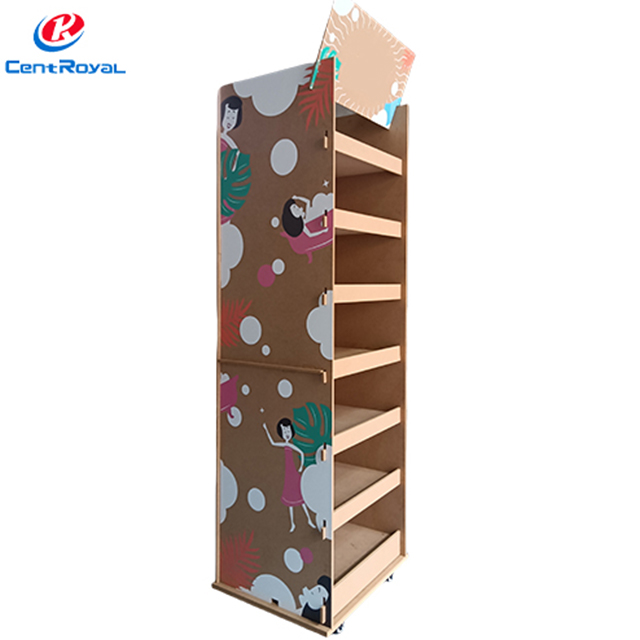
Mobility adds another layer of functional value on the store floor. A Themed rolling cardboard tiered display shelf integrates heavy-duty casters. This enables dynamic floor planning. Store managers can easily roll the unit from an endcap to an action alley based on weekend traffic patterns. Engineering multi-tier weight distribution is critical here. The base must support heavy or bulk items without bowing while in motion. You can apply seasonal thematic graphics via interchangeable headers and side panels. The core structure remains intact while the outward messaging shifts from Halloween to Thanksgiving.
Reinforced corrugated combined with wood or metal accents provides another strong option for heavy merchandise. Manufacturers use internal wireframes. Hidden metal supports sit within corrugated exteriors. This prevents the bowing and fatigue commonly seen in standard temporary units. The shopper sees a beautifully printed corrugated surface. The hidden skeleton does all the heavy lifting. We frequently use this technique for automotive fluids, large pet food bags, and bulk beverage cases.
Identify the heaviest single SKU in your product lineup to determine the required shelf load capacity.
Select a moisture-resistant base material like PVC or sealed wood if the unit will sit on a hard floor that receives daily scrubbing.
Incorporate hidden metal support bars under corrugated shelves if the campaign lasts longer than eight weeks.
Specify heavy-duty locking casters if store managers need to move the display for floor cleaning or layout changes.
You cannot deploy a display without strict adherence to retailer guidelines. Big-box and club stores enforce rigid constraints. Understanding structural regulations for full-pallet, half-pallet, and quarter-pallet units is mandatory. Costco, Sam's Club, and Walmart will reject non-compliant shipments at the distribution center. This results in massive logistical headaches and missed promotional windows. You must design the footprint to match their exact pallet specifications, including the type of wood used for the pallet itself.
Navigating these strict requirements takes precise engineering from the start. Pallet dimensions must match exact specifications, typically 48x40 inches for a full pallet. Maximum heights vary depending on the store zone. A center-aisle pallet might have a strict 54-inch height limit to maintain store sightlines, while an endcap might allow up to 60 inches. Shoppability angles dictate how easily a customer can grab the product. If your unit blocks sightlines or creates a tipping hazard, the retailer will pull it from the floor immediately.
Retail Environment | Typical Footprint | Height Restrictions | Key Compliance Focus |
|---|---|---|---|
Club Stores (Costco, Sam's) | Full Pallet (48" x 40") | Strictly enforced (often 52"-54") | No overhang, 360-degree shoppability, heavy load capacity |
Big Box (Walmart, Target) | Half or Quarter Pallet | Varies by department | Clean sightlines, easy restocking, cart bump resistance |
Grocery / Pharmacy | Endcap or Inline | Standard gondola height | Moisture resistance at base, narrow aisle clearance |
Spatial constraints change drastically based on placement. Aisle, endcap, and point-of-sale locations require different design adaptations. High-traffic endcap placements need robust corner protection. Shopping carts clip the corners of endcaps constantly. Inline shelves require precise depth measurements to avoid protruding into the aisle and violating ADA compliance. Island configurations demand 360-degree shoppability. Every side must present the product clearly and safely. You cannot have a "back" to an island display; it must drive sales from all angles.
Furthermore, club stores require displays to survive the journey from the distribution center directly to the concrete floor without any unpacking. The display acts as the shipping container. This means the structural integrity must withstand forklift handling, truck vibrations, and rough placement. We engineer these units with heavy corner posts and reinforced top trays to ensure they arrive intact. If the display leans or shifts during transit, the receiving manager will refuse the load.
Store associates must be able to maintain the unit effortlessly. Designing for easy replenishment prevents out-of-stock scenarios. If a display is hard to load, staff will ignore it, leaving your product in the backroom. Adjustable shelving accommodates varying SKU sizes. As your campaign inventory shifts from large boxes to small blister packs, the shelves must adapt. We use pegboard backings or slotted metal uprights to allow associates to move shelves up or down without tools.
Graphic refresh strategies extend the unit's active life significantly. You can update the facade, side skins, or headers without rebuilding the base structure. Utilizing magnetic graphics allows for instant swaps. Snap frames hold new promotional posters securely and look highly professional. Slip-on corrugated covers slide directly over the existing base for rapid seasonal transitions. This modularity keeps the brand messaging fresh while leveraging the initial structural investment.
Visual impact must remain consistent throughout the campaign. Print quality capabilities on hybrid materials vary. Litho-lamination works beautifully on reinforced corrugated, providing high-resolution imagery. Direct digital printing excels on rigid plastics, offering vibrant colors that resist scratching. You must match the print method to the substrate carefully. Integration of low-voltage LED lighting draws shopper attention in crowded aisles. Digital screens embedded in the structure provide dynamic product education, especially useful for consumer electronics or high-end cosmetics.
Maintenance also involves keeping the display clean. Dust accumulates on retail fixtures quickly. Materials like PVC and powder-coated metal allow for easy dusting and wiping. Raw corrugated absorbs dirt and looks dingy after a few weeks. By specifying wipeable surfaces on the top tiers and headers, you ensure the brand presentation remains sharp. We always recommend a clear protective laminate over any printed areas that shoppers will touch frequently.
Analyzing fabrication versus replacement costs reveals the true value of this merchandising approach. The break-even point often occurs at the three-month mark. Investing in one robust unit is mathematically superior to deploying three sequential temporary units. You eliminate the repeated costs of assembly, packing, and shipping. Every time you ship a new temporary display, you pay for freight, warehouse handling, and store-level labor. A single, durable unit bypasses these recurring logistical hurdles.
Shipping and logistics dictate structural design from the very beginning. Flat-pack models save massive amounts of freight space. You can fit hundreds of flat-packed units on a single truck. Pre-assembled shipping models reduce store-level labor but increase transport volume drastically. Dimensional weight considerations for hybrid materials require careful calculation. Heavy metal bases incur higher freight charges than hollow plastic components. We balance these factors by designing units that ship flat but assemble in under five minutes without tools.
Warehousing modular components impacts multi-phase rollouts. Storing interchangeable headers requires clean, dry space. The seasonal planning timeline demands realistic lead times. Design, prototyping, and retailer approval windows take weeks. Production and shipping logistics add months. You must manage campaign timing strictly to sync with major shopping holidays. If your back-to-school headers arrive in late August, the campaign is already dead.
Calculate the freight volume difference between shipping fully assembled units versus flat-pack designs.
Factor in the labor hours required for store associates to assemble complex units on the floor.
Establish a strict timeline that includes at least three weeks for retailer structural approval.
Plan your graphic refresh shipments to arrive two weeks before the seasonal transition date.
Prototyping is a non-negotiable phase in this timeline. You must build a physical sample, load it with actual product, and test it. We perform tilt tests, drop tests, and vibration tests to simulate the supply chain journey. Skipping the prototype phase to save time usually results in catastrophic failures on the store floor. A few weeks spent testing a hybrid structure ensures the entire rollout executes flawlessly.
Store-level execution failures derail great campaigns constantly. Complex assembly instructions lead directly to improper setup. Associates will abandon complicated units in the backroom. Engineering intuitive, tool-less assembly mitigates this risk. Tab-and-slot designs work perfectly for hybrid materials. Providing clear, visual instruction sheets or QR-code video guides ensures proper floor execution. If an associate needs a screwdriver to build your display, you have already failed.
Wear and tear in high-traffic zones destroys weak bases. Shopping carts and floor scrubbers constantly impact the bottom tier. Incorporating plastic mop trays protects the structure from water damage. Reinforced bases absorb cart impacts without denting. Utilizing durable materials for the bottom tier ensures the unit survives the entire campaign. We often specify a high-density polyethylene (HDPE) bumper around the bottom three inches of the display to deflect cart wheels.
End-of-life disposal presents sustainability challenges. Retailers push back heavily on non-recyclable mixed materials. Designing for disassembly solves this problem. Clearly labeling recyclable components guides store staff during the teardown process. Prioritizing eco-friendly inks and substrates aligns with modern corporate sustainability goals. You must make it easy for the store associate to separate the plastic shelves from the corrugated body before throwing them in the baler.
Another significant risk is product theft. High-value items placed on semi-permanent fixtures are vulnerable. We mitigate this by integrating subtle security features. Clear acrylic locking doors, tethered product samples, and angled shelving that prevents sweeping all help reduce shrink. You must balance product accessibility with security, ensuring legitimate shoppers can interact with the merchandise while deterring theft.
Semi-permanent displays represent the most adaptable merchandising format for sustained retail presence. They eliminate the constant replacement cycles of temporary units while avoiding rigid capital commitments. You gain floor flexibility, structural reliability, and dynamic graphic capabilities. By engineering hybrid structures, you protect your brand image and ensure your products remain shoppable throughout the entire campaign lifecycle.
Audit your upcoming seasonal campaign durations to identify programs lasting three to twelve months.
Request structural prototypes from manufacturers to test weight-bearing limits with your actual products.
Verify all specific retailer compliance guidelines regarding pallet dimensions and maximum heights.
Design your graphic refresh strategy upfront to ensure modular components are produced simultaneously.
Establish a clear end-of-life teardown plan for store associates to follow.
A: These units are engineered to last between three and twelve months in a standard retail environment. The exact lifespan depends heavily on store traffic, material selection, and how frequently store associates restock the shelves.
A: Temporary displays use standard corrugated cardboard and last one to three months. Semi-permanent displays utilize hybrid materials like reinforced corrugated, plastics, and metal accents to withstand longer campaigns and heavier product loads.
A: Yes. When engineered with internal wireframes, hidden metal supports, and heavy-duty casters, these mobile units can safely distribute and support the weight of bulk items and heavy beverage cases.
A: They can be fully compliant if designed to meet the specific dimensional, height, and shoppability requirements of the target retailer. You must engineer the footprint to match exact club store or big-box specifications.
A: Brands utilize modular graphic elements. Magnetic panels, snap frames, interchangeable headers, and slip-on corrugated covers allow you to refresh the visual messaging without replacing the core structural base.
A: Mixed materials can complicate recycling. To improve sustainability, design the unit for easy disassembly, clearly label all recyclable components, and utilize eco-friendly substrates and inks wherever possible.