Please Choose Your Language
Views: 0 Author: Site Editor Publish Time: 2026-08-24 Origin: Site
Selecting the right material for commercial displays is a highly strategic business decision. Procurement teams must balance upfront budgets against long-term brand perception. Store durability also plays a critical role in this calculation. The visual merchandising industry relies heavily on both solid timber and engineered composites for fixture rollouts. However, misaligning your material choice causes serious issues. You might face premature wear, warped fixtures, or bloated rollout budgets. We designed this guide to help you avoid these costly mistakes. This resource provides a transparent, evidence-based framework for retail owners. You will evaluate natural timber versus engineered composites objectively. You will learn how to match materials to specific store environments. We also outline how to manage compliance standards and optimize your procurement strategy.
Scalability vs. Prestige: MDF excels in multi-store rollouts requiring uniform, painted finishes, while solid wood signals premium quality for flagship or boutique environments.
Environmental Realities: Solid wood is vulnerable to warping in fluctuating humidity, whereas MDF offers dimensional stability but risks irreversible water damage.
Compliance is Non-Negotiable: Commercial MDF procurement must require CARB Phase 2 or EPA TSCA Title VI compliance to mitigate VOC and formaldehyde emissions.
You must first identify your core business problem. Retailers often struggle to match fixture lifespans to retail lease terms. A temporary pop-up shop demands different materials than a ten-year heritage flagship. Visual merchandising refresh cycles dictate how long a display must last. You need materials capable of surviving these specific operational timelines.
Before selecting materials, establish clear success criteria. We recommend evaluating every display project against four specific benchmarks:
Aesthetic alignment: The finish must match your brand identity perfectly.
Load-bearing requirements: Shelves must support your heaviest merchandise safely.
Shipping weight: Heavy fixtures increase logistics and freight costs dramatically.
Budget constraints: Material costs must align directly with your rollout funding.
You should view natural milled timber and engineered wood composites as specialized tools. They solve specific retail challenges rather than serving as aesthetic-only choices. Solid wood offers structural rigidity. MDF provides flat, predictable surfaces. Understanding these fundamental differences helps you make smarter procurement decisions.
Natural, un-engineered wood serves as the ultimate premium material. Manufacturers typically use species like Oak, Maple, or Pine for structural display components. These natural timbers bring warmth and authenticity to retail spaces. They require skilled craftsmanship but reward you by elevating the entire store atmosphere.
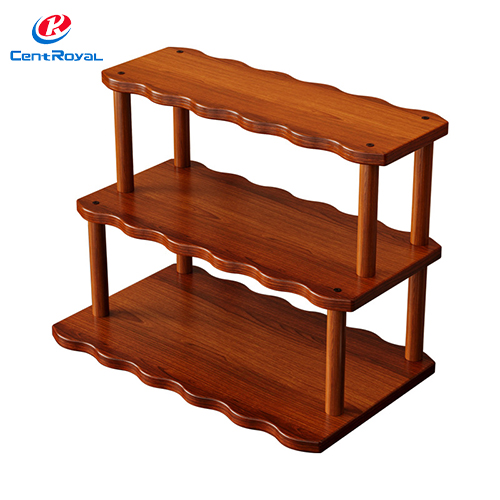
The merchandising advantages of natural timber are significant. A Solid Wood Rack delivers a unique, authentic grain pattern. This visual richness elevates perceived product value immediately. Luxury, heritage, or organic brands benefit immensely from this natural aesthetic. Furthermore, natural timber provides high structural integrity for heavy merchandise. You can also sand and refinish these surfaces. This repairability extends the fixture life despite scratches from high foot traffic.
However, implementation risks exist. You will encounter significant cost variance depending on the species chosen. Market availability also drives price fluctuations unpredictably. Natural timber remains highly susceptible to environmental expansion and contraction. Retail spaces require strict climate control and HVAC consistency. Without stable humidity, you risk severe warping or joint failure over time.
Medium-Density Fiberboard (MDF) dominates modern retail rollouts. Manufacturers create MDF by combining wood residuals, wax, and resin binders. They press these components under extreme high temperature and pressure. The resulting engineered composite lacks natural grain but provides unmatched consistency.
MDF offers compelling merchandising advantages. It provides a flawless, smooth surface. This texture proves ideal for high-gloss paint or decorative laminates. You can also apply real-wood veneers without knots or grain telegraphing. MDF boasts high dimensional stability. It will not warp or bow under normal temperature shifts. Predictable, uniform costs make it the undisputed standard for high-volume store rollouts.
You must also plan for its implementation risks. MDF is significantly heavier than many natural timbers. This density increases your freight and store installation costs. The material is also prone to edge-crushing. Furthermore, you face irreversible swelling if moisture compromises the protective seal. Aggressive floor mopping by retail cleaning crews frequently causes this exact damage.
Retail environments punish display fixtures daily. Natural timber dents upon heavy impact, but you can repair it easily. Maintenance teams can steam out minor dents or sand away deep scratches. Conversely, MDF edges chip under similar impact. You cannot simply sand an MDF chip. It requires replacement or specialized Bondo patching followed by repainting.
Fastener retention differs wildly between these materials. Natural timber holds screws repeatedly. You can disassemble and reassemble solid frames multiple times. MDF strips easily when you remove and reinsert screws. You must use specialized hardware for modular stands. We highly recommend using insert nuts or confirmat screws to prevent MDF joint failure.
The retail industry constantly debates the "healthier material" standard. Natural timber is naturally low-VOC. Its environmental safety depends almost entirely on your chosen paints or stains. Unfinished or natural-oil-finished timber provides excellent indoor air quality.
MDF requires strict compliance verification. Procurement teams must verify the use of low-emission binders. You must demand CARB Phase 2 or EPA TSCA Title VI certification. These certifications ensure safe indoor air quality for retail staff. They also protect your customers from harmful formaldehyde emissions.
Initial fabrication costs favor engineered composites heavily. MDF production is highly automated. CNC routers cut MDF sheets faster and cheaper than milling natural timber. You save substantial money during the initial manufacturing phase of any large rollout.
However, hidden costs emerge later. Freight weight increases because MDF is remarkably dense. Maintenance presents another challenge. A solid timber display often lasts over ten years. MDF fixtures typically function as consumable assets. They require replacement every three to seven years depending on veneer or laminate quality.
Material Comparison Summary
Feature | Solid Wood | Engineered MDF |
|---|---|---|
Surface Aesthetic | Authentic, unique natural grain | Smooth, uniform, ideal for paint |
Moisture Resistance | Moderate (can warp) | Low (swells irreversibly if unsealed) |
Repairability | High (sandable and stainable) | Low (requires patching/repainting) |
Fastener Holding | Excellent for repeated assembly | Poor (requires specialized insert nuts) |
Expected Lifespan | 10+ years | 3 to 7 years |
Smart retailers rarely limit themselves to a single material. We strongly recommend a hybrid construction strategy. You can use a solid timber frame for structural load-bearing capacity. The solid frame also provides crucial edge-wear protection. You then pair this frame with MDF shelving panels. The MDF handles flat, expansive surface areas cost-effectively.
Protecting your fixtures requires diligent edge banding and sealing. Retail cleaning crews use heavy water and aggressive chemicals. You must highlight the necessity of high-impact PVC or ABS edge banding on all MDF components. This plastic barrier prevents moisture ingress. It stops the engineered board from expanding and failing at the floor level.
Store updates present significant refinishing logistics. Retail spaces refresh their color palettes regularly. You can strip and restain natural timber in-situ or locally. This adaptability saves massive replacement costs. Conversely, MDF fixtures typically require full replacement. Alternatively, you might use architectural vinyl wrapping to change colors on existing MDF stands.
You need a clear decision framework before finalizing your purchase. Follow these guidelines to ensure maximum return on your fixture investment.
Choose Natural Timber if: You require high-end brand positioning. You have a low store count. You merchandise heavy localized product loads. Your brand messaging focuses heavily on sustainability or organic themes.
Choose MDF if: You are rolling out fifty or more stores simultaneously. You utilize painted or branded color-matching heavily. You operate on a rapid three-year visual merchandising cycle.
Vendor vetting is equally critical. You must ask actionable questions before ordering a Wood Diplay Stand. Ask your manufacturer, "What specific grade of MDF do you source?" Request their compliance certificates directly. If you specify natural timber, ask, "What joinery methods do you use to account for natural wood movement?" These questions quickly reveal a manufacturer's true expertise level.
Neither material holds a universally superior status in retail environments. Material effectiveness depends entirely on your specific retail application. Your rollout budget and brand tier dictate the best path forward. MDF offers unmatched scaling power and color consistency. Natural timber delivers structural longevity and premium aesthetic appeal.
Your next step requires proactive verification. We encourage buyers to request physical material samples immediately. Review all compliance documentation thoroughly before signing purchase orders. Finally, commission a physical prototype. Testing a single unit in your store environment prevents catastrophic failures during a full production run.
A: MDF cannot be made entirely waterproof. However, you can drastically improve its moisture resistance. High-quality edge banding protects the vulnerable sides. Melamine facing or polyurethane clear coats seal the flat surfaces effectively. These treatments defend the fixture against routine retail cleaning, though standing water will still cause damage.
A: Generally, yes. Natural timber has superior tensile strength. It resists sagging under sustained heavy loads, making it ideal for wine bottles or hardware. Wide MDF shelves require center supports or metal stiffeners to prevent visible bowing over time.
A: Natural timber is renewable but requires responsible forestry management, usually verified via FSC certification. MDF utilizes recycled wood scraps, which reduces landfill waste. However, MDF relies heavily on chemical resins. Both materials can be eco-friendly if you source them from certified, transparent vendors.
A: Yes, hybrid designs offer the best of both worlds. Using solid timber for high-touch areas like edges and legs ensures durability. Using MDF for expansive panels like shelves and backings controls your budget. This strategy optimizes both longevity and fabrication costs seamlessly.